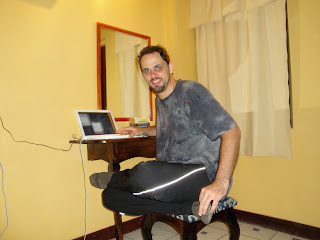
Friday, August 20, 2010

20 de agosto de 2010


It's Check Out Time...


¡Hola amigos! This will be one of my last posts, if not the last post, on the Colonia Libertad blog. Thanks for following. This time in Costa Rica has been interesting, wonderful, exasperating, challenging, and fun. I got to know my third rural community in much greater depth than either the New Mexican goat dairy or Numpaim del Noroeste in Ecuador. I was able to form bonds with families in that community that I hope will last a lifetime. And, I was able to get a firsthand taste of the difficulties of top-down organizing vis-á-vis the frustrations that I experienced while trying to teach English in a community with minimal interest in learning a foreign language.

I'd like to go over the history of this project and some of the highlights in this last post. I also hope to provide a sample of what I have learned about the culture of this stalwart people.

I found out about Project Ganas in December at a benefit dance with live music. I met Sara Sanford, the director of the project, who said that she was looking for people with teaching experience to go down to Costa Rica and live in the community. I was super excited about the prospect of returning to Costa Rica, where I had studied in 2007. After a brief interview, I decided it was for me. During the interview, I was told I had the choice between having my own house or staying with a family (a home stay). I opted for having my own house.

Of the information obtained in the interview, I wrote:

State educational resources in the area are lacking, creating the necessity for programs like Project Ganas -- a situation similar, but not identical, to what I discovered among rural indigenous groups during my 2007 study abroad. I am hoping to discover a new sense of solidarity within this community and examine their ties to one another and to the land as I continue to explore the concept of Traditional Ecological Knowledge vis á vis "sustainable" communities.

I had no idea. State educational resources in the area are nearly nonexistent. There is a school with four classrooms. All of the faculty except for two persons are part-time. The students receive less than three hours of education per day, including recess, which is often extended due to a lack of available staff. Materials to help the students, who are significantly behind in all subjects, are scarce. The first graders, half a year into their instruction, could not tell me the difference between five and six. The fifth graders could not explain the difference between three halves and three quarters. This is, in fact, similar to the situation faced by rural indigenous communities in Costa Rica.

I was able to form strong bonds with the community and learn about the community's agriculture. The agriculture of Colonia Libertad is "conventional," which means that they use chemicals to create healthy-looking monocrops. The people are generally aware of the environmental dangers of using such chemicals, but they are also unwilling to allow their crops to be eaten by the bugs. I have noted that the Shuar family I stayed with, the Chiriap, didn't seem particularly concerned about rainforest bugs in their family garden. I'm not sure what the differences in practice are that create the "necessity" for pesticide use, but it deserves further investigation. One obvious difference is that the "ranches" of Colonia Libertad are seen as permanent or semi-permanent spaces of food production, whereas the gardens of the Shuar are temporary and move from place to place on a cycle of anywhere from three to seven years. The Shuar also practice a swidden-fallow technique that could deter insect life from taking root. In addition, the Shuar view their environment as sacred, which the people of Colonia Libertad do not.

As for sustainability, I have noticed that since the time I began writing my thesis, environmental sustainability has become a catchphrase for just about any green label seeking to market its products to conscientious consumers. As such, it's become a topic I wish to avoid. I can say that the lifestyle of a person from Colonia Libertad is much less ecologically destructive than that of the average American (viz., citizen of the United States), but I can't make any judgments as to their overall sustainability. The Institución Costarricense de Electricidad (ICE) has overwhelmingly opted for "green" power producing options such as wind, water and geothermal energy, but I'm not sure that the energy consumption of the Colonia would be sustainable if it were forced to produce its own electricity. In addition, the demand for larger televisions and more powerful personal computers is bound to drive up the need for energy in the foreseeable future. The burning of plastic and other disposable products (styrofoam, paint containers, etc.) is of moderate environmental concern. The eutrophication of the immediate water supply is evident and most likely permanent as long as the current water system remains in place. There is a nearby river, jalapiedras, which has drinkable water and is suitable for bathing. There is also a steady water supply from a nearby mountain that seems likely to remain a good source of clean water for as long as the community population does not exceed the maximum water supply. All in all, I would say that the ecological health of this area is resilient and does not overtly threaten the existence of the nearby cloud forests.

Returning to the overview of my experience with the community, my welcome to the community was lukewarm and indicative of a lack of preparation. When I arrived in Colonia Libertad, people thought that I was perhaps the famed Peace Corps volunteer. I have since met the Peace Corps volunteer and I have decidedly decided that we are not the same person. She is fantastic, though; her name is Andrea and she has done a really good job of working with the local government to determine what types of projects the community would like to have in the works. I think that this would be a good angle for Project Ganas, too. If I'd had my druthers I would have liked to begin with the Association (the local government) to see how someone of my skills could have been of better use to the community. By the time I finally did meet with the Association, there had already been some major miscommunication and I wasn't able to establish clear objectives other than "come on over to my ranch sometime to talk history."

I would have liked to have learned a lot more about the history of the Colonia. I feel that I was able to learn a good deal about the culture and a rudimentary amount of history, but I would have liked to have had time to really explore in-depth the histories of individual people. I honestly feel that attempting to organize English classes in the community was such a waste of time. The people would have appreciated a person interested in their personal stories much more. I feel that when and if I come back to the community, I will make sure to dedicate some time to recording the histories of the community's members.

My first conversations with the community members were about religion. Religion forms a central part of the ontology of Colonia Libertad. There are two options for religion: Catholic, and Evangelical. People were surprised to learn that I had religious dietary preferences that they were unfamiliar with. Everyone in the community believes in God as the primary reason for the existence of everything they see and as the driving factor behind everything they experience, a fact that I found mildly annoying at first, but learned to accept. (I am an agnostic with some lifestyle habits left over from years of religious searching.) I even learned to say "Que Dios le acompañe" as a salutation when leaving, which means "May God go with you."

I found the stay in the community to be much different than I had imagined. For one thing, it was hotter than 100 degrees just about every day during March and April, and it was impossible for me to adjust to this steady high temperature. I was constantly dehydrated and often sick. There was not internet; I learned to travel to nearby Guayabo to be able to make my blog posts and keep in touch with friends. Eventually, I learned how to activate my iPhone in Costa Rica in order to spend less time away from the community. 3G phone service is the primary mode of access to the internet within Colonia Libertad, with Nokia being the preferred brand (Nokia makes internet tethering extremely intuitive). I became known as a technical go-to person, a guitar player and teacher, a singer and an adamant English professor. I felt that things in the community were going quite well.

Pet peeves of mine were the constant doubts about my living situation (detailed in prior blog posts) and the lack of a concrete schedule for teaching classes. I came to really like the night group, because at least they always met at the same time, even if they didn't always come to class. I became really good friends with the police across the street from the school, and they became my nightly audience as I played off all the songs I know on the guitar one by one. Eventually I was able to find a fan in Guayabo and I was able to cool off a little bit. I also got accustomed to the Colonia Libertad dialect of Spanish. I learned that a teja was 100 colones and a caña was 1,000. I learned that "si la güila se cae, se va a romper la choya." (If the little girl falls, she's going to break her head.) I learned that "al chile" means "la pura verdad" (the whole truth). I can now maintain a conversation with anyone from this area.

I've already talked enough in other posts about leaving the school and moving in with a host family, so I don't see any point in belaboring the subject. When I was told that I couldn't continue to teach the school students that I came here to teach, my opinion about the whole project changed irrevocably. Honestly, I should have just stopped trying to teach English at that point and started doing a bit of history or ethnography. The last three months could have been put to much better use. And truly, as a male in this community, in order to be seen as part of the community you have to get up in the morning and go do something that has to do with farming or community infrastructure. It took me a while to learn this, and once I learned it, it sort of frightened me. I knew that, with my flat feet already taxed from walking on rocks all day, and having suffered several sprained ankles already, there was no way that I was going to be able to do physical labor. This is exactly what makes me doubt the integration of differently-abled persons within subsistence farming communities, although I am told that there are communities that do it quite well.

And so, I was halfway wrong about the community's "work ethic." I was working mostly with youth who seemed to be apathetic and interested in material wealth, but I didn't get to know the elder generation until I moved in with a family and was able to observe their lifestyle. When I did, I came to the conclusion that the community is in crisis, and not just because of a lack of Western academic education. The spirit of the community seems to be dying, or at least undergoing major transformation. The twenty- and thirty-year-olds either have major developmental problems (e.g., alcoholism), are involved in work that does not involve agriculture, are raising children, or have permanently moved out of the community. The teenagers do not seem to be interested in agriculture. Hence, the community as it stands today may have a certain amount of economic and/or ecological resilience, but the outlook for the future is not what I would consider hopeful.

I'm going to leave it there for now, I may try to post again in the near future with some pictures (if I can find a decent internet connection) and a few last words. In the mean time, if you're looking for more reading material, you can check out my guest blog at
mexmigration, a history and politics of Mexican Migration blog. I will also be opening up a personal blog to share my thoughts about searching for a job in the recession, which might cover more than one geographical location and will deal with the continued difficulties faced by a recent college grad trying to find work (me). I hope you'll check it out.

Until the next time, then!

From Escazú, Costa Rica
Chaim S. Eliyah

Wednesday, August 4, 2010

4 de agosto de 2010

There but for the grace of God, go I

Today officially marks two weeks since my return to Colonia Libertad. It's been an interesting time and I think I'll be going back a little sooner than expected.

I just poured beans from an old plastic gas can (I don't think it ever had any gas in it, but who can be sure?) into a metal bowl to be used in the kitchen. Doña Magdalena, my host mother, explained to me that the beans are grown, dried in the sun, and then put into the plastic cans at night, which are then capped off during the day (all of this to prevent "sweating" or the beans getting little bubbles). I also learned that these beans can be put right back into the old ground in December to make beans for the next year! Wow :)

I finally started English classes last night; none of the former students could get together until then, and new students have been hard to find. To paraphrase my friend from the Peace Corps, there's just not much interest in learning English here.

I'm going to complain for a while now. To skip the complaining, click here.

After coming back to town, my host mother described me as "sad." I suppose I have been a little sad about the overall outcome of this trip. After being kicked out of the elementary school, lied to about the possibility of continuing to teach at the high schools, and reduced to teaching a single night class in which only five people stayed the course, you could say I lost a bit of the enthusiasm I came here with. When I first started teaching English here, you would have thought I was reading from the gospel of St. John. But after seeing the results of my labor drift into the wind several times, I'm feeling a bit more like Job.

Several days ago, Pablo from Finca La Anita came to tell me that my host father had gone to the Asociación de Desarrollo Integral (The Association of Integral Development), which is the governing body of the town, to talk about the nature of my stay at his house. He purportedly said, in a nutshell, that it's costly to have me around, that there didn't seem to be any classes, that I should work out some kind of rent with my host family, that I didn't seem to be conforming to the rules of a fairly religious household (viz., I've had my girlfriend over late at night), and that they've had a lot of problems with volunteers who are afraid of work. I tried to take this speech in stride as much as I could, although for me it was quite the slap in the face. I have organized classes four times here, and was in the process of doing so again when Pablo had this talk with me. I explained to Pablo that it's sometimes a little hard to get the community moving right away, and that I thought a week and a half was still within the reasonable time limit for organizing classes. I also explained to him that I am a volunteer and that I'm not prepared to pay rent while I'm working for free. He replied that he would never do volunteer work, but that the volunteers who have been respected in the community have been the volunteers who were out sweating trying to build the community. It definitely seems like there is a lot more respect here for physical endeavors than intellectual ones. I guess I feel like if I had signed up for physical labor it would be one thing. I was told there was a need for teachers and that I would be a teacher in this community.

Pablo's response to everything was basically "I'm just the messenger." This is interesting, because I tried to follow his advice and take these matters up with Changuelo (my host dad) at some point later that evening. Changuelo admitted he had talked with the former President of the Association (they just changed governments) but said that he was asking for support for me, the volunteer, from the Association. I'm not sure what got lost in translation, but I know that I am just about fed up with having to deal with drama and politics here in the community. It's entirely true that a visitor to a foreign culture cannot expect the culture to conform to them (Pablo's words), but I have bent over backwards to be as easygoing and dependable as possible, I have knocked on all the right doors, I have offered the best of myself even when I knew I was being lied to, I have fixed more than half of the computers in the community for free or next to nothing (sometimes more than once), and I'm just not getting paid enough to deal with this crap anymore.

To make matters worse, I stopped by the police station the yesterday to talk to my friends there, and they informed me that someone wrote a letter to the police department saying that I should be investigated as a terrorist suspect because of my name. As near as I can tell, this didn't come down from INTERPOL or the CIA or anything of the sort; this was a letter from a local community member. Apparently the U.S. is exporting more than just beans these days.

Well, there are some positive notes. I got word from El Centro de la Raza that they absolutely loved the 60-plus pages of translation that I did for them. If you're interested in seeing the results maybe you should check out their Learn, Teach and Grow maternity classes in the fall. They're going to give me a letter of reference as a translator! YEAH! Also, the class last night went swimmingly well. There was plenty of laughter and learning, a good consensus about what type of schedule we should have. A lot of the students are now able to translate basic English phrases on their own. Lo veo como el Gollo: sólo bueno. (There's a business here in Costa Rica called "Gollo" that has the advertising slogan "Only Good." I see it like Gollo: Only Good.)

So, I'm sorry for the rather negative blog post. It's been grey skies down here. I'm coming back August 26th and I'm going to grab the first thing that looks like a real job and just get lost in work for a while. It could be Starbuck's for all I care. Most of all, though, I'm sorry to the people in the community who really want to see me stay longer. I've formed a lot of positive bonds here and I hope those will develop into some kind of ongoing relationship in the future. Maybe Project Ganas' dream of having an early childhood and maternity education center here in the Colonia will come true after all.

Until then, I will be excited to come home and see all of my friends in Seattle and Keizer.

From Colonia Libertad,

Chaim Shalom Ammi Eliyah

Saturday, July 24, 2010

24 de julio de 2010


Back in La Colonia, Back in La Colonia, Back in La Colonia Libertad
(sung to the tune of Back in the U.S.S.R. by The Beatles)


Well it's back to the daily grind, if you consider being lost in the cloud forests of Costa Rica to be a grind. I like to think of it as more of a sauna, given the heat and humidity here. As in, "I'm off to the daily sauna, I'll see you later."

I arrived in Costa Rica on Monday and made my way to the 25 de julio neighborhood by taxi, where I was greeted by my beautiful partner. After some much sought-after gallo pinto (a Costa Rican plate consisting of rice mixed with beans), avocado and natilla, we headed off to a hotel room in Liberia. After putting my bags inside, we met up with our hairstylist friend to have a couple of drinks. I discovered that a blue margarita is very much like a regular margarita, but blue. I enjoyed two of them before changing back to my regular fare.

On Tuesday, I headed to Guayabo, the nearest thing to Colonia Libertad that could be considered a city. Guayabo reminds me a lot of Walla Walla, Washington, except that there's no prison. Instead, the town seems to thrive on various forms of consumerism. There's a furniture store (the kind where they make their own furniture, like the one owned by my friend's family in Ecuador), a domestic electronics outlet of ALFA, several clothing stores (sporting American clothing styles), a clinic, a dentist, a stadium, and a lot of houses and cheap motels known as cabinas. Among these I've selected a favorite, run by the Ledezma family (Cabinas Ledezma, +1 (506) 2673-0608).

I stayed in Guayabo a couple of days while I tied to make sure I had everything that I needed for my stay in the country. We met up with my partner's aunt, who lent us her husband's SUV for a day. We ended up traveling out to Bagaces and buying some Bailey's and Bacardi Añejo, then going back to the aunt's house to party with the aunt and two underage persons, who shall remain nameless. ;~)

So, since about two days ago I have been back in Colonia Libertad. I've been received with smiles and a lot of questions about my journey to Seattle. I have been doing my best to cope with the heat; yesterday, I went through three towels and as many shirts.

First I stopped at my partner's house and said hello to her grandparents. Her grandfather is the town plumber, in the sense that when the water goes out, he's the go-to guy. As a matter of fact, later on today he and I will be headed to the headwaters of the community's water supply. I'll try to take some pictures. His name is Ines, and he worked thirty years as a police officer in these parts. His wife's name is Trinidad, and she has had (as near as I can tell) nine children, most of whom live outside the community. Only one, my neighbor Laura, has stayed behind with her son.

After lunch, I started trying to track down the artifacts I left in La Colonia and began moving back into my room at Changuelo and Magdalena's house. Changuelo is a subsistence farmer who moved here with Magdalena from El Porvenir when she was 15 (I'm not sure how old he was, but it was a runaway wedding). El Porvenir is about a four hour walk to the north, along the Nicaraguan border. The garden that these two have would put most small farms to shame. In case you're wondering, it resembles the huerta familiar of Mayan repute.

I slept late the next day, probably on account of the heat. When I finally got up and around I spent most of the day organizing my things. I was invited to a presentation at Finca La Anita, where high school students from Minneapolis, Minnesota presented their findings on their experiments with leaf-cutter ants. This is of particular interest to the community because leaf-cutter ants have been destroying a lot of the crops around here.

Leaf-cutter ants, atta colombica, are among the more interesting species that I have come across. Like all ants, they have a queen, who lays several different types of eggs. There are basically four sizes of worker ants, all of whom have different roles within the colony. These are called minims, minors, mediae, and majors. The ants themselves are farmers; they eat a special type of fungus, which they feed with the greens that they collect from all around their nest. The ants also produce an anti-fungicidal medicine (for the fungus) from various types of bacteria that they collect from the environment.

All of these activities are obviously of particular interest to biology students, who were quite excited to be studying and experimenting with the colonies in La Colonia. (Yes, the irony is pretty thick.) The students did experiments on how to erase the ants' scent trail with bleach and alcohol, how to get the ants to select different food based on sugar content, and observations to determine what types of bacteria are found on the ants' bodies.

I haven't contacted any of the high school students or faculty yet about the possibility of publishing their results here, but I would like to note that bleach is one of the major contributers to eutrification, and both bleach and alcohol will kill just about anything that doesn't have skin (and, in sufficient quantities, those species that do). Killing microfauna is a bad ecological decision because it furthers the biodiversity-reducing effects of reductionist agriculture. So, while I understand that both alcohol and bleach supposedly break down in sunlight, I would just like to express my objection to using these chemicals as methods of pest control. The Shuar use no such chemicals in their gardens, and they seem to manage to avoid several species of rainforest ants.

Well, that's all for now and my internet toy has run out of battery juice. I will try to post some pictures, really I will, I promise. I'll probably upload a bunch of photos to Picasa for all to see, and I'll post the link in a few days.

Until then, take care of your environment.

From Colonia Libertad,

Chaim

Monday, June 28, 2010

30 de junio de 2010

Back in Seattle...

Hey everyone. So the first round of English classes finished in Costa Rica about a week and a half ago, with five students having completed the basic English course. There isn't a whole lot of other news about Costa Rica. I swear at some point I will go through my photo album and try to add some pictures here. If you're connected with me on Facebook, I already posted a mountain of pictures there. (Was that Spanglish?)

Coming back has been an interesting experience. I still had some bites from the rainforest dwellers that I wanted to get checked out while I was here, and one of my friends--who was gracious enough to open her door for me--freaked out about the bites and decided she couldn't stand even a minute possibility of parasites living in her apartment. Understandable, I suppose, but now I am basically living out of my car. I've seen the inside of a couple of motels and I've stayed a few nights now with an old friend of mine from the Jobs with Justice days.

I never could stay in one place anyway.

Calls to Costa Rica and computer operating systems are still in Spanish. Everything else is in English. It's funny how quickly your second language can slip away while your mother tongue always stays fixed in your mind. My translation work for El Centro de la Raza is going at a snail's pace. I would like to just get it done but I am too busy procrastinating; I'm supposed to be studying for Saturday's English GRE test, and so of course everything in the world seems more interesting, which is probably why I finally got around to this blog post. When I actually start "studying," I guess I'll probably finish the translation. And life goes on.

I managed to pick up a day of work last week for an interesting political campaign. The legislature of Washington state, from what I understand, has approved a tax on candy and soft drinks to help save health care and education. It's worth about $300 million to the state budget, according to one source. So naturally, national and state companies put together a campaign to block this bill. I was able to work with one of several organizations trying to save the bill. I saw it as a microcosm of the daily struggle between the financial interests of large companies and governmental entities tying to balance their budgets. While I was working on the campaign, I also got to find out a little bit more about the organizing going on behind I-1098, the "Tax the Rich" campaign. It seems like a lot of people are very excited about this prospect. Filmmaker and Seattle historian Shaun Scott has remarked that similar campaigns have already happened in Washington several times before, most notably in the 1930s, 1970s and 1980s. It will be interesting to see if, in light of recent financial events, we are actually able to pull it off this time without facing some type of major catastrophe.

I wonder how much of the state budget goes to cleaning up candy wrappers and soda bottles from our sidewalks, streets and highways? One thing I have noticed since coming back here is that we produce, as part of our daily routine, a considerably greater amount of waste than they do in Colonia Libertad. Sure, we don't burn our plastic--most of it winds up in our rivers, lakes and streams and eventually finds its way to the ocean--but we do use a lot of it. That, and styrofoam, and all sorts of labels and decals and wrappers and clothing tags and bumper stickers and a whole host of other things that you just don't find in a place like Colonia Libertad. Of course, we're not comparing apples to apples here; this is a bustling metropolis, and Colonia Libertad is a community of less than 500 people. Still, if you added up enough Colonia Libertads to equal the population of a city the size of Seattle, I'm pretty sure the Colonia Libertads of the world would be producing less trash than Seattle, and that's something to think about.

Well, before I get into another discussion about how nobody really wants to be poor and a lot of people think they're poor but really aren't as poor as the people who have no resources to fall back on even when they're cash poor, I think I'll leave it there and go find some coffee somewhere. And yes, I will BEG the barista to not put a plastic lid on my cup.

From Seattle,

Chaim Eliyah


Tuesday, June 8, 2010

8 de junio de 2010

You guessed it! Rice and beans!

Hey everyone. It's been a long month, sorry for not writing. Some time at the end of May I got kicked out of la casa de los maestros. It's kind of a long story. I was initially told that someone in Aguas Claras had complained to the Ministry of Education, and for that reason I couldn't give classes anymore and had to move. Then my former roommate told me that surely I was looking for someone to blame and she hoped I wouldn't blame her. Then, last week, I found out that nobody at the high schools in Colonia Blanca or Aguas Claras knew anything about a complaint at the level of the Ministry of Education. I'm chalking it up to a married mother's desire to not have a male roommate and the general desire in this part of the world to avoid direct confrontation.

So, after pounding the gravel (there's no pavement) a little, I have managed to organize new English classes with the support of the Development Association, which is more or less the governing body of Colonia Libertad. I am staying in the guest room of the house of two benevolent and wonderful people, Changuelo and Magdalena. Changuelo is a subsistence farmer who worked for years at the nearby ranch but is now retired. Magdalena is a housewife and the mother of nine children, some of whom still live here in the community. There are less mosquitoes (zancudos) here than there were by la casa de los maestros, but every once in a while those and other bugs still come around to nibble. I pay less attention to their nibbling now, although I am still having minor allergic reactions so some of the bites. I have a plug from Raid that has little exchangeable tabs that are "lightly toxic" and have the pleasant effect of killing all the mosquitoes in the room. I also have a fan, which seems to scare them off for some reason. I don't think I'll be dying of hemorrhagic dengue, but if I do, I'll be sure to blog it.

I am now giving free intensive English classes to the community for three hours a day each day. Between lesson plans and correcting homework, this takes a good chunk out of the day, but I am still finding time to play guitar and argue with film producers and Environmental Justice professors. If there's anything that can change a state-eschewing Marxist's mind about the world, it's coming to live in a backwoods, roughneck Christian community in the middle of Central America. I've learned to accept my nationality with stride, to identify with the materialist desires of the youth here (to do otherwise would make me a total hypocrite), and to be thankful for whatever guiding force is driving my interactions with the community. My attitude about Christianity is still the same: The bible sucks, but Jesus was pretty cool. But my appreciation for the love of human beings acting within the context of a community has grown immensely. The only thing that kind of bothers me is the way people treat their pets here. But you know what they say, never look a gift horse in the mouth.

Rice and beans form the centerpiece of any meal here. You can expect a couple of plantains (they may not be ripe) and rice and beans no matter what the other ingredients are. As much as I love rice and beans, I have to admit that every once in a while I crave a big ol' pizza or some fettuccine alfredo. The really interesting thing is that even though we live in the middle of a farming community, food is often brought in from well outside the community. At the house where I live, ants are a big problem and have been eating the crops; other farmers in the area are involved mostly in cattle ranching. There are relatively few farms that grow the area's staples. Changuelo just supervised the planting of a huerta escolar at the school, so soon the school will be growing their own corn and yucca. The students are expected to take part in this process, but I don't know to what extent they will.

The smell of burning plastic really bothers me. It's not just that I know that the dioxins can give us all cancer, it's that I don't understand why so much plastic is allowed into a community that can't process the resulting waste. I suppose it's like that in the whole world and that's why we've got all that plastic floating in the ocean:

http://news.nationalgeographic.com/news/2009/08/090820-plastic-decomposes-oceans-seas.html

Still, I have to admit that I do use products with plastic even though I try to avoid it. I'm trying to take a proactive role in educating the community about the dangers of plastic, and recently the Asociación said they might be interested in getting a truck to haul recyclables out of the community once a week or so. More on this later.

Mostly I am grappling with the same concepts as the Asociación; how to give this community the economic resources that it wants and needs without destroying its knowledge of subsistence farming and its sense of autonomy. When I came here, my biggest concern was teaching English; now, I see languages as a tool and I think the real problems are much more complex than any one set of theories would suggest. For instance, one major threat to the community is the breakdown of families within the last generation. The conservative bloc in my mind swears that this is because liberalism has eschewed family values, and part of me knows that this is true. Our individualism and our careers have become more important to us as a people than maintaining our family relations, and this phenomenon is spreading across cultures. You can blame capitalism or you can say that the state should stay out of family affairs, or you can start a debate if you like about whether clans or families came first, but I think it is noteworthy that our sense of community has become so diluted that many of us prefer corporate responsibilities and solitary lifestyles to communal living. People here think I'm friendly, but emotionally distant, and honestly I find it a little hard to imagine living as they do, i.e. in constant contact with one another, all the time!

Speaking of which, I am going to finish this blog post off and try to post again soon. I really want to go through my recent facebook discussions and apply the arguments there to what I am learning here. At some point I also want to do an in-depth discussion of the differences between living in Ecuador, among the Shuar, and the lifestyle of the Colonia here. I will be working on those posts, but in the mean time I am going to think about what might be for dinner.

See you next time,

Chaim Eliyah